McUtils.Zachary
Handles much of the higher-order “numerical math” stuff inside Mcutils which has made it balloon a little bit Deals with anything tensor, Taylor expansion, or interpolation related
Members
Examples
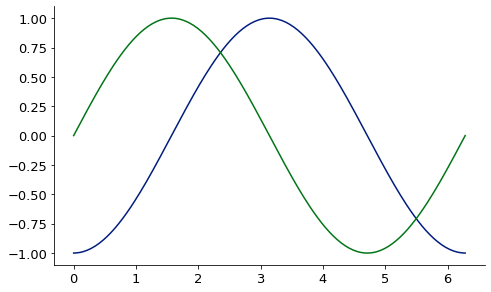
1D finite difference derivative via finite_difference:
from McUtils.Zachary import finite_difference
import numpy as np

sin_grid = np.linspace(0, 2*np.pi, 200)
sin_vals = np.sin(sin_grid)

deriv = finite_difference(sin_grid, sin_vals, 3) # 3rd deriv
base = Plot(sin_grid, deriv, aspect_ratio = .6, image_size=500)
Plot(sin_grid, np.sin(sin_grid), figure=base)
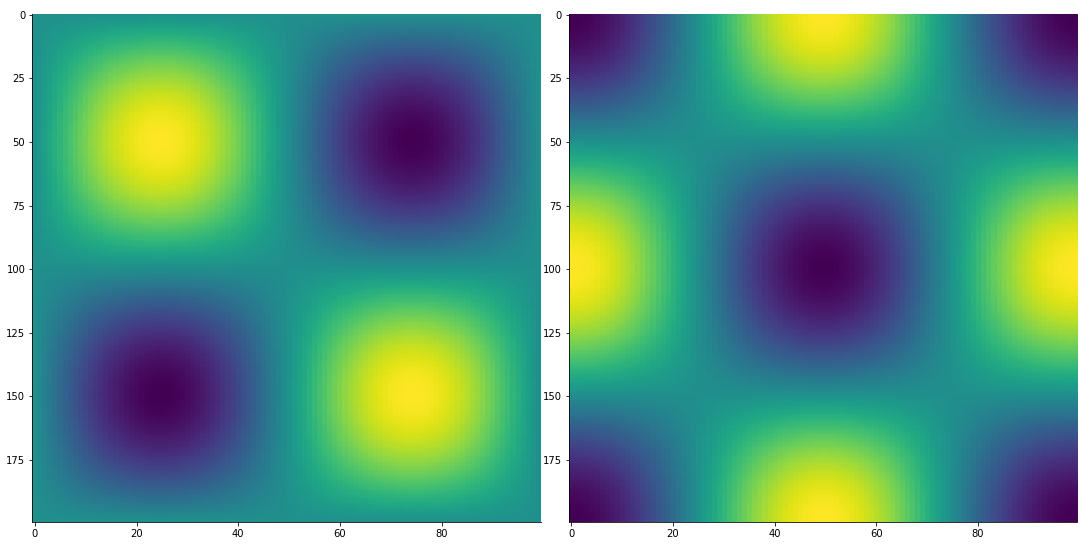
2D finite difference derivative via finite_difference:
from McUtils.Zachary import finite_difference
import numpy as np

x_grid = np.linspace(0, 2*np.pi, 200)
y_grid = np.linspace(0, 2*np.pi, 100)
sin_x_vals = np.sin(x_grid); sin_y_vals =  np.sin(y_grid)
vals_2D = np.outer(sin_x_vals, sin_y_vals)
grid_2D = np.array(np.meshgrid(x_grid, y_grid)).T

deriv = finite_difference(grid_2D, vals_2D, (1, 3))
TensorPlot(np.array([vals_2D, deriv]), image_size=500)
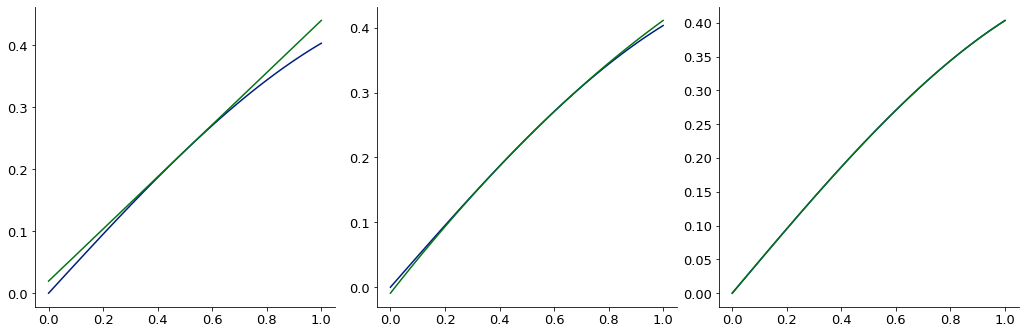
Create a convenient, low-order expansion of a (potentially expensive) function
def sin_xy(pt):
    ax = -1 if pt.ndim>1 else 0
    return np.prod(np.sin(pt), axis=ax)

point = np.array([.5, .5])
# create the function expansions
exp1 = FunctionExpansion.expand_function(sin_xy, point, function_shape=((2,), 0), order=1, stencil=5)
exp2 = FunctionExpansion.expand_function(sin_xy, point, function_shape=((2,), 0), order=2, stencil=6)
exp4 = FunctionExpansion.expand_function(sin_xy, point, function_shape=((2,), 0), order=4, stencil=6)

# create a test grid and plot the approximations
test_grid = np.vstack([np.linspace(-.5, .5, 100), np.zeros((100,))]).T + point[np.newaxis]
g = test_grid[:, 0]
gg = GraphicsGrid(nrows=1, ncols=3, subimage_size=350)
for i, e in zip(range(3), (exp1, exp2, exp4)):
    # plot the real answer
    gg[0, i] = Plot(g, sin_xy(test_grid), figure=gg[0, i])
    # plot the expansion
    gg[0, i] = Plot(g, e(test_grid), figure=gg[0, i])
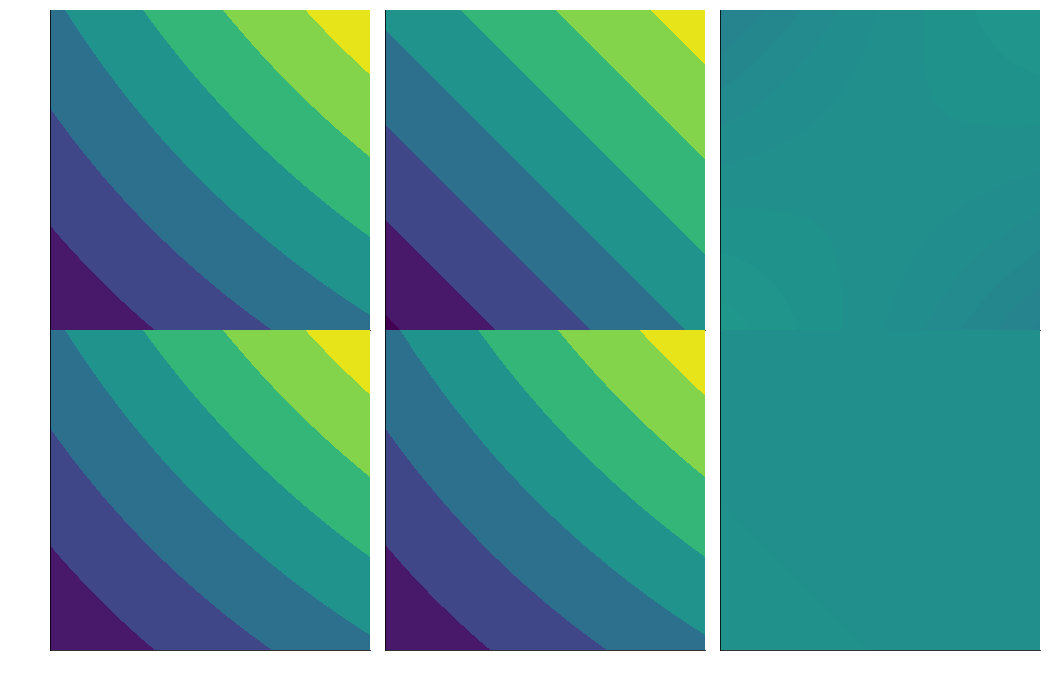
expansions work in multiple dimensions, too
mesh = np.meshgrid(np.linspace(.4, .6, 100, dtype='float128'), np.linspace(.4, .6, 100, dtype='float128'))
grid = np.array(mesh).T
gg2 = GraphicsGrid(nrows=2, ncols=3, subimage_size=350)
# plot error in linear expansion
styles = dict(ticks_style=(False, False), plot_style={'vmin': np.min(sin_xy(grid)), 'vmax': np.max(sin_xy(grid))})
gg2[0, 0] = ContourPlot(*mesh, sin_xy(grid), figure=gg2[0, 0], **styles)
gg2[0, 1] = ContourPlot(*mesh, exp1(grid), figure=gg2[0, 1], **styles)
# when we plot the error, we shift it so that it's centered around the average function value to show the scale
# of the error
gg2[0, 2] = ContourPlot(*mesh,
                        np.marginalize_out([np.min(sin_xy(grid)), np.max(sin_xy(grid))]) + sin_xy(grid) - exp1(grid),
                        figure=gg2[0, 2], **styles)
# plot error in quadratic expansion
gg2[1, 0] = ContourPlot(*mesh, sin_xy(grid), figure=gg2[1, 0], **styles)
gg2[1, 1] = ContourPlot(*mesh, exp2(grid), figure=gg2[1, 1], **styles)
gg2[1, 2] = ContourPlot(*mesh,
                        np.marginalize_out([np.min(sin_xy(grid)), np.max(sin_xy(grid))]) + sin_xy(grid) - exp2(grid),
                        figure=gg2[1, 2], **styles)
- stirs
- bin_gs
- bins
- facs
- fd_weights
- uneven_weights
- finite_difference
- FD2D
- FD2D_multi
- FDDeriv
- FDDeriv2
- FiniteDifferenceParallelism
- TensorTerms
- TensorConversion
- PseudopotentialTerms
- ExplicitPoly
- TensorDerivatives
- ExpandFunction
- ExpansionDerivs
- MultiExpansion
- Polys
- SparseShifts
- SparseArrayPoly
- SparseConvolve
- LinSpaceMesh
- MeshGridMesh
- StructuredMesh
- UnstructuredMesh
- RegularMesh
- RegMeshSubgrids
- SemiStructuredMesh
- MeshFromList
- ParametricCurveInterpolation
- RegularGridInterpolatorND
- Interpolator1D
- InterpolatorExtrapolator2D
- InterpolatorExtrapolator1D
- RegularInterpolator3D
- IrregularInterpolator3D
- TensorExpressionEfficiency
- RBFInterp1D
- RBFInterpolator
- RBFInterpolatorResiliance
- HigherElementaryDerivs
- RBFTiming
- RBFForms
- Symbolics
- CoordinateFunctions
- InternalReexpansions
Before we can run our examples we should get a bit of setup out of the way. Since these examples were harvested from the unit tests not all pieces will be necessary for all situations.
All tests are wrapped in a test class
class ZacharyTests(TestCase):
    def setUp(self):
        self.save_data = TestManager.data_gen_tests
    def __getstate__(self):
        return {}
    def __setstate__(self, state):
        pass
    def get_error(self, ref_vals, vals):
        err = np.abs(vals - ref_vals)
        cum_err = np.linalg.norm(err.flatten())
        max_err = np.max(err.flatten())
        mean_err = np.average(err.flatten())
        return err, cum_err, max_err, mean_err
    def plot_err(self, grid, ref_vals, vals, errs):
        if grid.ndim == 1:
            Plot(grid, ref_vals, figure=Plot(grid, vals))
            Plot(grid, errs[0]).show()
        elif grid.ndim == 3:
            g = (grid[:, :, 0], grid[:, :, 1])
            gg = GraphicsGrid(nrows=2, ncols=2)
            gg[0, 0] = ContourPlot(*g, ref_vals, figure=gg[0, 0])
            gg[1, 0] = ContourPlot(*g, vals, figure=gg[1, 0])
            gg[1, 1] = ContourPlot(*g, errs[0], figure=gg[1, 1])
            gg[0, 0].tight_layout()
            gg.show()
    def print_error(self, n, order, errs):
        print(
            "Order: {}.{}\nCumulative Error: {}\nMax Error: {}\nMean Error: {}".format(n, order, *errs[1:])
        )
    class harmonically_coupled_morse:
        # mass_weights = masses[:2] / np.sum(masses[:2])
        def __init__(self,
                     De_1, a_1, re_1,
                     De_2, a_2, re_2,
                     kb, b_e
                     ):
            self.De_1 = De_1
            self.a_1 = a_1
            self.re_1 = re_1
            self.De_2 = De_2
            self.a_2 = a_2
            self.re_2 = re_2
            self.kb = kb
            self.b_e = b_e

        def __call__(self, carts):
            v1 = carts[..., 1, :] - carts[..., 0, :]
            v2 = carts[..., 2, :] - carts[..., 0, :]
            r1 = nput.vec_norms(v1) - self.re_1
            r2 = nput.vec_norms(v2) - self.re_2
            bend, _ = nput.vec_angles(v1, v2)
            bend = bend - self.b_e

            return (
                    self.De_1 * (1 - np.exp(-self.a_1 * r1)) ** 2
                    + self.De_2 * (1 - np.exp(-self.a_2 * r2)) ** 2
                    + self.kb * bend**2
            )
    def constructSparseArray(cls, shape, n_els):
        from McUtils.Numputils import SparseArray

        np.random.seed(1)
        inds = np.unique(np.array([np.random.choice(x, n_els) for x in shape]).T, axis=0)
        vals = np.random.rand(len(inds))
        inds = inds.T

        # `from_data` for backend flexibility
        return SparseArray.from_data(
            (
                vals,
                inds
            ),
            shape=shape
        )
stirs
    def test_stirs(self):
        stir = StirlingS1(8)
        ans = np.array([
            [1,  0,    0,     0,     0,   0,    0,  0],
            [0,  1,    0,     0,     0,   0,    0,  0],
            [0, -1,    1,     0,     0,   0,    0,  0],
            [0,  2,   -3,     1,     0,   0,    0,  0],
            [0, -6,    11,   -6,     1,   0,    0,  0],
            [0,  24,  -50,    35,   -10,  1,    0,  0],
            [0, -120,  274,  -225,   85, -15,   1,  0],
            [0,  720, -1764,  1624, -735, 175, -21, 1]
        ])
        # print(stir, file=sys.stderr)
        self.assertAlmostEqual(np.round(np.linalg.norm(stir-ans), 6), 0.)
bin_gs
    def test_bin_gs(self):
        gbin = GammaBinomial(7/2, 8)
        ans = np.array([1., 3.5, 4.375, 2.1875, 0.273438, -0.0273438, 0.00683594, -0.00244141])
        # print(gbin, file=sys.stderr)
        self.assertAlmostEqual(np.round(np.linalg.norm(gbin-ans), 5), 0.)
bins
    def test_bins(self):
        gbin = Binomial(8)
        ans = np.array([
            [1, 0, 0,  0,  0,  0,  0, 0],
            [1, 1, 0,  0,  0,  0,  0, 0],
            [1, 2, 1,  0,  0,  0,  0, 0],
            [1, 3, 3,  1,  0,  0,  0, 0],
            [1, 4, 6,  4,  1,  0,  0, 0],
            [1, 5, 10, 10, 5,  1,  0, 0],
            [1, 6, 15, 20, 15, 6,  1, 0],
            [1, 7, 21, 35, 35, 21, 7, 1]
        ])
        # print(gbin, file=sys.stderr)
        self.assertAlmostEqual(np.sum(gbin-ans), 0.)
facs
    def test_facs(self):
        facs = Factorial(8)
        ans = np.array([1, 1, 2, 6, 24, 120, 720, 5040])
        # print(facs, file=sys.stderr)
        self.assertAlmostEqual(np.linalg.norm(facs-ans), 0.)
fd_weights
    def test_fd_weights(self):
        coeffs = RegularGridFiniteDifference.get_weights(3, 7/2, 7)
        ans = [ -0.0192708, 0.259896, -2.02969, 4.92448, -4.92448, 2.02969, -0.259896, 0.0192708 ]
        coeffs2 = RegularGridFiniteDifference.get_weights(3, 0, 7)
        ans2 = [
            -8.058333333333334, 42.53333333333333, -98.225,
            129.66666666666666, -106.04166666666667, 53.6,
            -15.408333333333333, 1.9333333333333333
        ]
        # print(coeffs2, file=sys.stderr)
        r1 = np.round(np.linalg.norm(coeffs-ans), 5)
        r2 = np.round(np.linalg.norm(coeffs2-ans2), 10)
        self.assertAlmostEqual(r1 + r2, 0.)
uneven_weights
    def test_uneven_weights(self):
        import numpy as np
        weights = IrregularGridFiniteDifference.get_weights
        uweights =  [
            weights(2, 0, np.array([-2, -1, 0, 1, 2])),
            weights(1, 0, np.array([-3/2, -1/2, 1/2, 3/2])),
            weights(1, 1, np.array([-3, -2, -1, 0, 1]))
            #weights(3, 1/2, np.array([0, 1/3, 1, 2, 7/2, 6]))
            ]
        eweights = RegularGridFiniteDifference.get_weights
        targ_weights = [
            eweights(2, 2,   4),
            eweights(1, 3/2, 3),
            eweights(1, 4,   4)
        ]
        passed = True
        for e, w in zip(targ_weights, uweights):
            norm = np.linalg.norm(e-w[-1])
            if norm > .000001:
                passed = False
                print((norm, e, w[-1]), file=sys.stderr)
        self.assertIs(passed, True)
finite_difference
    def test_finite_difference(self):

        sin_grid = np.linspace(0, 2 * np.pi, 200)
        sin_vals = np.sin(sin_grid)
        deriv = finite_difference(sin_grid, sin_vals, 1) # 3rd deriv

        sin_grid = np.arange(0, 1, .001)
        sin_vals = np.sin(sin_grid)
        sin_d3_vals = -np.cos(sin_grid)

        if self.save_data:
            f = h5py.File(TestManager.test_data('fd_data_1D.hdf5'),'w')
            f.create_dataset("vals", data=sin_vals)
            f.create_dataset("ref", data=sin_d3_vals)

        print_error = False
        plot_error = False

        ref_vals = np.cos(sin_grid)
        for ord in range(2, 10):
            n = 1
            sten = ord
            # core_dvals = sin_d_vals[math.floor(sten/2):-math.floor(sten/2)]
            vals = finite_difference(sin_grid, sin_vals, n, stencil=sten, end_point_accuracy=0,
                                        mode="sparse"
                                        )

            errs = self.get_error(ref_vals, vals)
            if plot_error:
                self.plot_err(sin_grid, ref_vals, vals, errs)
            if print_error:
                self.print_error(n, ord, errs)
            self.assertLess(errs[1], .1/ord)

        ref_vals = -np.sin(sin_grid)
        for ord in range(3, 10):
            n=2
            sten = ord
            vals = finite_difference(sin_grid, sin_vals, n, stencil=sten, end_point_accuracy=0,
                                        mode="dense"
                                        )

            errs = self.get_error(ref_vals, vals)
            if plot_error:
                self.plot_err(sin_grid, ref_vals, vals, errs)
            if print_error:
                self.print_error(n, ord, errs)
            self.assertLess(errs[1], .05 / ord)

        ref_vals = sin_d3_vals
        for ord in range(4, 10):
            n = 3
            sten = ord
            vals = finite_difference(sin_grid, sin_vals, n, ord, stencil=sten, end_point_accuracy=2,
                                        mode="sparse"
                                        )

            errs = self.get_error(ref_vals, vals)
            if plot_error:
                self.plot_err(sin_grid, ref_vals, vals, errs)
            if print_error:
                self.print_error(n, ord, errs)
            self.assertLess(errs[1], .05 / ord)
FD2D
    def test_FD2D(self):

        print_error = False
        plot_error = False

        x_grid = np.linspace(0, np.pi, 200, dtype=np.longdouble)
        y_grid = np.linspace(0, np.pi, 100, dtype=np.longdouble)

        sin_x_vals = np.sin(x_grid); sin_y_vals = np.sin(y_grid)
        cos_x_vals = np.cos(x_grid); cos_y_vals = np.cos(y_grid)
        vals_2D = np.outer(sin_x_vals, sin_y_vals)
        grid_2D = np.array(np.meshgrid(x_grid, y_grid)).T

        # x_grid_new = np.linspace(0, 2 * np.pi, 200)
        # y_grid_new = np.linspace(0, 2 * np.pi, 100)
        #
        # sin_x_vals = np.sin(x_grid_new); sin_y_vals = np.sin(y_grid_new)
        # vals_2D = np.outer(sin_x_vals, sin_y_vals)
        # grid_2D = np.array(np.meshgrid(x_grid, y_grid)).T
        #
        # deriv = finite_difference(grid_2D, vals_2D, (1, 3))
        #
        #
        # deriv = finite_difference(grid_2D, vals_2D, (1, 1))
        # deriv = finite_difference(grid_2D, vals_2D, (1, 2))
        # deriv = finite_difference(grid_2D, vals_2D, (1, 3))

        # try 1st and 1st derivs
        test_11 = True
        if test_11:
            ref_vals = np.outer(cos_x_vals, cos_y_vals)
            for ord in range(3, 7, 2):
                n = (1, 1)
                vals = finite_difference(grid_2D, vals_2D, n, stencil=ord, end_point_accuracy=1)

                errs = self.get_error(ref_vals, vals)
                if plot_error:
                    self.plot_err(grid_2D, ref_vals, vals, errs)
                if print_error:
                    self.print_error(n, ord, errs)
                self.assertLess(errs[1], .1 / ord)

        # 1,2 mixed deriv
        test_12 = True
        if test_12:
            ref_vals = -np.outer(cos_x_vals, sin_y_vals)
            for ord in range(3, 7, 2):
                n = (1, 2)
                vals = finite_difference(grid_2D, vals_2D, n, stencil=ord, end_point_accuracy=1)

                errs = self.get_error(ref_vals, vals)
                if plot_error:
                    self.plot_err(grid_2D, ref_vals, vals, errs)
                if print_error:
                    self.print_error(n, ord, errs)
                self.assertLess(errs[1], .05 / ord)

        # 2,2 mixed deriv
        test_23 = True
        if test_23:
            only_core = True
            ref_vals = np.outer(sin_x_vals, cos_y_vals)
            for ord in range(5, 10):
                n = (2, 3)
                vals = finite_difference(grid_2D, vals_2D, n,
                                         stencil=ord,
                                         end_point_accuracy=2,
                                         only_core=True
                                         )

                floop = np.math.floor(ord/2)
                if only_core:
                    refs = ref_vals[floop:-floop, floop:-floop]
                    grfs = grid_2D[floop:-floop, floop:-floop]
                else:
                    refs = ref_vals
                    grfs = grid_2D

                errs = self.get_error(refs, vals)
                if plot_error:
                    self.plot_err(grfs, refs, vals, errs)
                if print_error:
                    self.print_error(n, ord, errs)
                self.assertLess(errs[1], .05)


        # 1,4 mixed deriv
        test_14 = True
        if test_14:
            ref_vals = np.outer(cos_x_vals, sin_y_vals)
            only_core = True
            for ord in range(6, 8):
                n = (1, 4)
                # vals = finite_difference(grid_2D, vals_2D, n,
                #                          stencil=ord, end_point_accuracy=2,
                #                          only_core = only_core
                #                          )
                vals = finite_difference(grid_2D, vals_2D, n,
                                         stencil=ord, end_point_accuracy=2,
                                         only_core = only_core
                                         )


                floop = np.math.floor(ord / 2)
                if only_core:
                    refs = ref_vals[floop:-floop, floop:-floop]
                    grfs = grid_2D[floop:-floop, floop:-floop]
                else:
                    refs = ref_vals
                    grfs = grid_2D

                errs = self.get_error(refs, vals)
                if plot_error:
                    self.plot_err(grfs, refs, vals, errs)
                if print_error:
                    self.print_error(n, ord, errs)
                self.assertLess(errs[1], .5)
FD2D_multi
    def test_FD2D_multi(self):

        print_error = False
        plot_error = False

        x_grid = np.arange(0, 1, .01, dtype=np.longdouble)
        y_grid = np.arange(0, 1, .001, dtype=np.longdouble)
        sin_x_vals = np.sin(x_grid); sin_y_vals =  np.sin(y_grid)
        cos_x_vals = np.cos(x_grid); cos_y_vals =  np.cos(y_grid)
        vals_2D = np.outer(sin_x_vals, sin_y_vals)
        grid_2D = np.array(np.meshgrid(x_grid, y_grid)).T

        # try 1st and 1st derivs
        test_11 = True
        if test_11:
            ref_vals = np.outer(cos_x_vals, cos_y_vals)
            for ord in range(3, 7, 2):
                n = (1, 1)
                nreps = 15
                vals = finite_difference(
                    np.broadcast_to(grid_2D, (nreps,) + grid_2D.shape),
                    np.broadcast_to(vals_2D, (nreps,) + vals_2D.shape),
                    n,
                    stencil=ord,
                    end_point_accuracy=1,
                    contract = True
                )

                errs = self.get_error(ref_vals, vals)
                if plot_error:
                    self.plot_err(grid_2D, ref_vals, vals, errs)
                if print_error:
                    self.print_error(n, ord, errs)
                self.assertLess(errs[1], .1 / ord)
FDDeriv
    def test_FDDeriv(self):
        # ggrid = GraphicsGrid(nrows=1, ncols=2)

        fdf = FiniteDifferenceDerivative(np.sin, stencil = 5)
        grid = np.linspace(0, 2*np.pi, 5)
        diff_fun = fdf(grid, mesh_spacing = .1)
        d = np.array([-.2, -.1, 0, .1, .2])
        raw = np.array([
            finite_difference(
                c + d,
                np.sin(c + d),
                (1,),
                stencil=5, only_center = True, end_point_accuracy=0
                ) for c in grid
        ])

        self.assertLess(np.linalg.norm(diff_fun[0] - raw), .00001)
        self.assertIsInstance(diff_fun[0, 0, 0][0], (float,))
FDDeriv2
    def test_FDDeriv2(self):
        def test(gps):
            x = gps[..., 0]
            y = gps[..., 1]

            return x * np.sin(y)

        fdf = FiniteDifferenceDerivative(test, function_shape=((2, ), 1), stencil = 5)

        npts = 25
        grid = np.linspace(0, 2*np.pi, npts)
        grid2D = np.meshgrid(grid, grid)
        gps = np.array(grid2D).T
        diff_fun = fdf(gps)

        diff_fun[0, 0]

        self.assertEquals(diff_fun[0, 0].shape, (npts, npts))

        self.assertEquals(diff_fun[0, :].shape, (1, 2, npts, npts)) # should I implement this with a squeeze...?
        self.assertEquals(np.linalg.norm((diff_fun[:, :][1, 0] - diff_fun[1, 0]).flatten()), 0.)
FiniteDifferenceParallelism
    def test_FiniteDifferenceParallelism(self):

        re_1 = 0.9575
        re_2 = 0.9575
        b_e = np.deg2rad(104.5)
        internals = [
            [0, -1, -1, -1],
            [1, 0, -1, -1],
            [2, 0, 1, -1]
        ]
        # internals = None
        coords = np.array([
                [0.000000, 0.000000, 0.000000],
                [re_1, 0.000000, 0.000000],
                np.dot(
                    nput.rotation_matrix([0, 0, 1], b_e),
                    [re_2, 0.000000, 0.000000]
                )
            ])

        erg2h = UnitsData.convert("Ergs", "Hartrees")
        cm2borh = UnitsData.convert("InverseAngstroms", "InverseBohrRadius")
        De_1 = 8.84e-12 * erg2h
        a_1 = 2.175 * cm2borh

        De_2 = 8.84e-12 * erg2h
        a_2 = 2.175 * cm2borh

        hz2h = UnitsData.convert("Hertz", "Hartrees")
        kb = 7.2916e14 / (2 * np.pi) * hz2h

        morse = self.harmonically_coupled_morse(
            De_1, a_1, re_1,
            De_2, a_2, re_2,
            kb, b_e
        )

        deriv_gen = FiniteDifferenceDerivative(morse,
                                               function_shape=((None, None), 0),
                                               mesh_spacing=1e-3,
                                               stencil=9,
                                               logger=Logger(),
                                               parallelizer=MultiprocessingParallelizer()#, verbose=True)
                                               ).derivatives(coords)

        with BlockProfiler("With parallelizer"):
            pot_derivs = deriv_gen.derivative_tensor([1, 2, 3, 4, 5, 6, 7])

        deriv_gen = FiniteDifferenceDerivative(morse,
                                               function_shape=((None, None), 0),
                                               mesh_spacing=1e-3,
                                               logger=Logger(),
                                               stencil=9,
                                               ).derivatives(coords)

        with BlockProfiler("Without parallelizer"):
            pot_derivs = deriv_gen.derivative_tensor([1, 2, 3, 4, 5, 6])
TensorTerms
    def test_TensorTerms(self):

        n_Q = 10
        n_X = 20
        x_derivs = [
            np.random.rand(n_Q, n_X),
            np.random.rand(n_Q, n_Q, n_X),
            np.random.rand(n_Q, n_Q, n_Q, n_X),
            np.random.rand(n_Q, n_Q, n_Q, n_Q, n_X)
            ]
        v_derivs = [
            np.random.rand(n_X),
            np.random.rand(n_X, n_X),
            np.random.rand(n_X, n_X, n_X),
            np.random.rand(n_X, n_X, n_X, n_X)
            ]
        terms = TensorExpansionTerms(x_derivs, v_derivs)

        q1 = terms.QX(1)
        self.assertEquals(str(q1), 'Q[1]')

        q11 = terms.QX(1) + terms.QX(1)
        self.assertEquals(str(q11), 'Q[1]+Q[1]')

        qshift = q11.shift(2, 1)
        self.assertEquals(str(qshift), '[Q[1]+Q[1]|2->1]')

        vQ = terms.QX(1).dot(terms.XV(1), 2, 1)
        self.assertEquals(str(vQ), '<Q[1]:2,1:V[1]>')

        self.assertIsInstance(vQ, TensorExpansionTerms.ContractionTerm)
        # self.assertIsInstance(vQ.simplify(), TensorExpansionTerms.BasicContractionTerm)

        vdQQ = vQ.dQ()
        self.assertIn("V[2]", str(vdQQ))
        self.assertIn("<Q[2]:3,1:V[1]>", str(vdQQ))

        vdQQQQ = vdQQ.dQ().dQ().reduce_terms()
        self.assertIsInstance(vdQQQQ, TensorExpansionTerms.SumTerm)
        self.assertEquals(len(vdQQQQ.terms), 15)

        # arr = vdQQQQ.array

        xv_derivs = [
            [None, np.random.rand(n_Q, n_X, n_X)],
            [None, np.random.rand(n_Q, n_Q, n_X, n_X)]
            ]

        mixed_terms = TensorExpansionTerms(x_derivs, v_derivs, qxv_terms=xv_derivs)

        vdQ = mixed_terms.QX(1).dot(mixed_terms.XV(1), 2, 1)

        mixed_vdQXX = vdQ.dQ().dQ().reduce_terms()

        vdQQQQ_subbed = mixed_vdQXX.dQ().reduce_terms()

        self.assertEquals(len(vdQQQQ_subbed.terms), 14)

        self.assertEquals(vdQQQQ_subbed.array.shape, (n_Q, n_Q, n_Q, n_Q))
TensorConversion
    def test_TensorConversion(self):

        n_Q = 10
        n_X = 20
        np.random.seed(1)
        x_derivs = [
            np.random.rand(n_Q, n_X),
            np.random.rand(n_Q, n_Q, n_X),
            np.random.rand(n_Q, n_Q, n_Q, n_X),
            np.random.rand(n_Q, n_Q, n_Q, n_Q, n_X)
        ]
        v_derivs = [
            np.random.rand(n_X),
            np.random.rand(n_X, n_X),
            np.random.rand(n_X, n_X, n_X),
            np.random.rand(n_X, n_X, n_X, n_X)
        ]
        xv_derivs = [
            [None, np.random.rand(n_Q, n_X, n_X)],
            [None, np.random.rand(n_Q, n_Q, n_X, n_X)]
            ]

        t = TensorDerivativeConverter(x_derivs, v_derivs)
        new = t.convert()
        self.assertEquals(len(new), 4)
        self.assertEquals(new[1].shape, (n_Q, n_Q))

        t2 = TensorDerivativeConverter(x_derivs, v_derivs, mixed_terms=xv_derivs)
        new = t2.convert()
        self.assertEquals(len(new), 4)
        self.assertEquals(new[1].shape, (n_Q, n_Q))


        trace_derivs = TensorExpansionTerms([0, 0, 0, 0, 0], [0, 0, 0, 0, 0])
        t1 = trace_derivs.QX(1).tr().dQ()
        self.assertEquals(str(t1), 'Tr[Q[2],2+3]')

        t1 = trace_derivs.QX(1).det().dQ().dQ()

        t1 = trace_derivs.QX(1).inverse().dQ()
PseudopotentialTerms
    def test_PseudopotentialTerms(self):

        n_Q = 10
        np.random.seed(1)
        n_X = 3

        i_derivs = [
            np.random.rand(n_X, n_X),
            np.random.rand(n_Q, n_X, n_X),
            np.random.rand(n_Q, n_Q, n_X, n_X),
            np.random.rand(n_Q, n_Q, n_Q, n_X, n_X)
        ]
        # for x in i_derivs: # symmetrize
        #     inds = np.indices(x.shape).T.reshape(-1, x.ndim)
        #     for i in inds:
        #         n_X_part = i[-2:]
        #         n_Q_part = i[:-2]
        #         parent = np.concatenate([np.sort(n_Q_part), np.sort(n_X_part)])
        #         x[i] = x[parent]
        i_terms = TensorExpansionTerms(i_derivs[1:], None, base_qx=i_derivs[0], q_name='I')
        detI = i_terms.QX(0).det()

        g_derivs = [
            np.random.rand(n_Q, n_Q),
            np.random.rand(n_Q, n_Q, n_Q),
            np.random.rand(n_Q, n_Q, n_Q, n_Q),
            np.random.rand(n_Q, n_Q, n_Q, n_Q, n_Q)
        ]
        # for x in g_derivs: # symmetrize
        #     inds = np.indices(x.shape).T.reshape(-1, x.ndim)
        #     for i in inds:
        #         n_X_part = i[-2:]
        #         n_Q_part = i[:-2]
        #         parent = np.concatenate([np.sort(n_Q_part), np.sort(n_X_part)])
        #         x[i] = x[parent]
        g_terms = TensorExpansionTerms(g_derivs[1:], None, base_qx=g_derivs[0], q_name='G')
        detG = g_terms.QX(0).det()
        self.assertIsInstance(detG.array, float)
        self.assertEquals(detG.array, np.linalg.det(g_derivs[0]))

        new_tr = g_terms.QX(0).tr()
        self.assertEquals(new_tr.array.shape, ())
        self.assertTrue(np.allclose(new_tr.array, np.trace(g_derivs[0])))

        new_inv = ~g_terms.QX(0)
        self.assertTrue(np.allclose(new_inv.array, np.linalg.inv(g_derivs[0])))

        newdQ = detG.dQ()
        self.assertEquals(newdQ.array.shape, (n_Q,))

        i_derivs = [
            np.random.rand(n_X, n_X),
            np.random.rand(n_Q, n_X, n_X),
            np.random.rand(n_Q, n_Q, n_X, n_X),
            np.random.rand(n_Q, n_Q, n_Q, n_X, n_X)
        ]
        # for x in i_derivs: # symmetrize
        #     inds = np.indices(x.shape).T.reshape(-1, x.ndim)
        #     for i in inds:
        #         n_X_part = i[-2:]
        #         n_Q_part = i[:-2]
        #         parent = np.concatenate([np.sort(n_Q_part), np.sort(n_X_part)])
        #         x[i] = x[parent]
        i_terms = TensorExpansionTerms(i_derivs[1:], None, base_qx=i_derivs[0], q_name='I')
        detI = i_terms.QX(0).det()

        gam = detG / detI
        self.assertEquals(gam.array.shape, ())
        self.assertTrue(np.allclose(gam.array, detG.array / detI.array))
        self.assertTrue(np.allclose(gam.array, np.linalg.det(g_derivs[0]) / np.linalg.det(i_derivs[0])))


        five_gam = 5 * detG / detI
        self.assertAlmostEquals(five_gam.array, 5 * detG.array / detI.array, 8)

        inv_gam = 1/gam
        self.assertEquals(inv_gam.array.shape, ())
        self.assertTrue(np.allclose(inv_gam.array, detI.array / detG.array))
        self.assertEquals(inv_gam.array, 1/gam.array)

        gamdQ = gam.dQ().simplify(check_arrays=True)

        self.assertEquals(gamdQ.array.shape, (n_Q,))
        # self.assertEquals(gamdQQ.array.shape, (n_Q, n_Q))

        # wat = g_terms.QX(0).dot(gamdQQ, [1, 2], [1, 2])
        # self.assertEquals(wat.array.shape, ())

        wat_2 = g_terms.QX(1).dot(gamdQ, 3, 1).tr()
        self.assertEquals(wat_2.array.shape, ())
        wat_21 = g_terms.QX(2).tr(axis1=1, axis2=4)
        self.assertEquals(wat_21.array.shape, (n_Q, n_Q))
        self.assertTrue(np.allclose(wat_21.array, np.trace(g_derivs[2], axis1=0, axis2=3)))


        doot = gamdQ.dot(g_terms.QX(0), 1, 1)
        self.assertEquals(doot.array.shape, (n_Q,))

        wat_3 = -3 / 4 * gamdQ.dot(doot, 1, 1)
        self.assertEquals(wat_3.array.shape, ())

        wat_4 = -3 / 4 * inv_gam * gamdQ.dot(doot, 1, 1)
        self.assertEquals(wat_4.array.shape, ())

        wat_5 = inv_gam * wat_3
        self.assertTrue(np.allclose(wat_4.array, wat_5.array))

        I0, I0Q, I0QQ = i_derivs[:3]
        G, GQ, GQQ = g_derivs[:3]

        detI = np.linalg.det(I0); invI = np.linalg.inv(I0); adjI = invI * detI
        detG = np.linalg.det(G); invG = np.linalg.inv(G); adjG = invG * detG


        invIdQ_new = i_terms.QX(0).inverse().dQ()
        invIdQ = - np.tensordot(np.tensordot(invI, I0Q, axes=[-1, 1]), invI, axes=[-1, 0]).transpose(1, 0, 2)
        self.assertEquals(invIdQ_new.array.shape, invIdQ.shape)
        self.assertTrue(np.allclose(invIdQ_new.array, invIdQ))

        invGdQ = - np.tensordot(np.tensordot(invG, GQ, axes=[-1, 1]), invG, axes=[-1, 0]).transpose(1, 0, 2)

        # not quite enough terms to want to be clever here...
        nQ = GQ.shape[0]
        ## First derivatives of the determinant
        detIdQ = np.array([
            np.trace(np.dot(adjI, I0Q[i]))
            for i in range(nQ)
        ])
        detIdQ2 = np.trace(
            np.tensordot(adjI, I0Q, axes=[1, 1]),
            axis1=0,
            axis2=2
        )
        detI_new = i_terms.QX(0).det()
        detIdQ_new = detI_new.dQ()
        self.assertTrue(np.allclose(detIdQ2, detIdQ))
        self.assertEquals(detIdQ_new.array.shape, detIdQ.shape)
        self.assertTrue(np.allclose(detIdQ_new.array, detIdQ))

        detGdQ = np.array([
            np.trace(np.dot(adjG, GQ[i]))
            for i in range(nQ)
        ])
        detG_new = g_terms.QX(0).det()
        detGdQ_new = detG_new.dQ()
        self.assertEquals(detGdQ_new.array.shape, detGdQ.shape)
        self.assertTrue(np.allclose(detGdQ_new.array, detGdQ))

        # two_dot = g_terms.QX(0).dot(gamdQQ, [1, 2], [1, 2])
        # self.assertTrue(np.allclose(two_dot.array, np.tensordot(g_terms.QX(0).array, gamdQQ.array, axes=[[0, 1], [0, 1]])))
        gamdQ = (detI_new.dQ()/detI_new + -1 * detG_new.dQ()/detG_new).simplify(check_arrays=True)
        detI_new.name = "|I|"
        gamdQ_I_new = (detI_new.dQ()/detI_new).simplify(check_arrays=True)
        # raise Exception(gamdQ_I_new)

        ## Derivatives of ln Gamma
        gamdQ_I = 1 / detI * detIdQ
        gamdQ_G = 1 / detG * detGdQ
        gamdQ_og = gamdQ_I - gamdQ_G

        self.assertTrue(np.allclose(gamdQ.array, gamdQ_og))

        adjIdQ = detI * invIdQ + detIdQ[:, np.newaxis, np.newaxis] * invI[np.newaxis, :, :]
        np.array([
            np.trace(np.dot(adjI, I0Q[i]))
            for i in range(nQ)
        ])
        detIdQQ = np.array([
            [
                np.tensordot(I0Q[i], adjIdQ[j].T, axes=2)
                + np.tensordot(adjI, I0QQ[i, j].T, axes=2)
                for i in range(nQ)
            ]
            for j in range(nQ)
        ])
        detIdQQ_real = np.array([
                [
                    np.trace(np.dot(I0Q[i], adjIdQ[j]))
                    + np.trace(np.dot(adjI, I0QQ[i, j]))
                    for i in range(nQ)
                ]
                for j in range(nQ)
            ])

        detIdQQ2_terms = [
            np.tensordot(I0Q, adjIdQ, axes=[[1, 2], [2, 1]]).T,
            np.tensordot(adjI, I0QQ, axes=[[1, 0], [2, 3]]).T
        ]

        detIdQQ2 = np.sum(detIdQQ2_terms, axis=0)

        detIdQQ_new = detIdQ_new.dQ().simplify(check_arrays=True)

        adjI_new = i_terms.QX(0).det() * i_terms.QX(0).inverse()
        self.assertTrue(np.allclose(adjI_new.array, adjI))

        adjIdQ_new = adjI_new.dQ().simplify()
        self.assertTrue(np.allclose(adjIdQ_new.array, adjIdQ))

        self.assertTrue(np.allclose(detIdQQ2, detIdQQ))
        self.assertEquals(detIdQQ_new.array.shape, detIdQQ.shape)
        self.assertTrue(np.allclose(detIdQQ_new.array.T, detIdQQ))

        gamdQQ_I = -1 / detI ** 2 * np.outer(detIdQ, detIdQ) + 1 / detI * detIdQQ

        gamdQQ_I_new = gamdQ_I_new.dQ().simplify(check_arrays=True)

        # raise Exception(gamdQ_I_new, gamdQQ_I_new)
        # raise Exception(gamdQQ_I_new.array.T, gamdQQ_I[0])
        self.assertTrue(np.allclose(gamdQQ_I_new.array.T, gamdQQ_I))
ExplicitPoly
    def test_ExplicitPoly(self):
        a = FunctionExpansion.from_indices(
            {
                (): 1,
                (0,): 2
            },
            ndim=2
        )
        self.assertTrue(np.allclose(
            a([
                [[1, 2], [.5, 2]],
                [[1, 3], [.5, 3]],
                [[1, 4], [.5, 4]]
            ]),
            np.array([
                [3, 2],
                [3, 2],
                [3, 2],
            ])
        ))
TensorDerivatives
    def test_TensorDerivatives(self):
        # a = TensorExpression.TermVector([TensorExpression.CoordinateTerm(0, 2), TensorExpression.CoordinateTerm(1, 2)])

        def plus_1(x):
            return x+1
        crds = TensorExpression.ScalarFunctionTerm(
            TensorExpression.CoordinateVector(2, name="coord_vec"),
            f={'function':plus_1, 'derivatives':lambda inds: (lambda *_:1) if isinstance(inds, int) or len(inds) == 1 else (lambda *_:0)},

        )
        expr = TensorExpression.OuterPowerTerm(crds, 2)

        e2 = TensorExpression.OuterPowerTerm(
            TensorExpression.ScalarFunctionTerm(
                TensorExpression.CoordinateVector([1, 2], name="coord_vec"),
                f={'function': plus_1,
                   'derivatives': lambda inds: (lambda *_: 1) if isinstance(inds, int) or len(inds) == 1 else (
                       lambda *_: 0)},

            ), 2)
        self.assertTrue(np.allclose(
            TensorExpression(expr.dQ(), coord_vec=np.array([1, 2])).eval(),
            e2.dQ().array
        ))

        nv = TensorExpression.VectorNormTerm(TensorExpression.CoordinateVector(2, name="coord_vec"))
        self.assertEquals(TensorExpression(nv, coord_vec=np.array([1, 2])).eval(), np.linalg.norm([1, 2]))
        self.assertTrue(np.allclose(
            TensorExpression(nv.dQ().dQ(), coord_vec=np.array([1, 2])).eval(),
            [
                [0.357771, -0.178885],
                [-0.178885, 0.0894427]
            ]
        ))

        np.random.seed(0)
        crd = np.random.rand(5)
        wat = TensorExpression.VectorNormTerm(
            TensorExpression.CoordinateVector(5, name="coord_vec")
        )
        crd_vals = TensorExpression.ArrayStack((3,), np.array([crd, crd, crd]))
        res = TensorExpression(wat, coord_vec=crd_vals).eval()
        self.assertEquals(res.shape, (3,))
        wat_d = wat.dQ()
        dq_res = TensorExpression(wat_d, coord_vec=crd_vals).eval()
        self.assertEquals(dq_res.shape, (3, 5))
        slow_mode = np.array([
            TensorExpression(wat_d, coord_vec=x).eval()
            for x in crd_vals.array
        ])
        self.assertTrue(np.allclose(dq_res, slow_mode))

        wat_dd = wat.dQ().dQ()
        dqq_res = TensorExpression(wat_dd, coord_vec=crd_vals).eval()
        self.assertEquals(dqq_res.shape, (3, 5, 5))
        slow_mode = np.array([
            TensorExpression(wat_dd, coord_vec=x).eval()
            for x in crd_vals.array
        ])
        self.assertTrue(np.allclose(dqq_res, slow_mode))

        pts = np.array([[-0.32498609, -0.29857954],
                        [-0.29112237, -0.48247142],
                        [-0.19237367, -0.28342343],
                        [-0.40490118, -0.2155546],
                        [-0.31110323, -0.10724408]])
        pts = TensorExpression.ArrayStack((5,), pts)

        term = TensorExpression.OuterPowerTerm(
            TensorExpression.CoordinateVector(2, name="pts"),
            2
        )

        # self.assertEquals(TensorExpression(term, pts=pts).eval().shape, (5, 2, 2))
        self.assertEquals(TensorExpression(term.dQ(), pts=pts).eval().shape, (5, 2, 2, 2))

        pts = np.array([[-0.32498609, -0.29857954],
                        [-0.29112237, -0.48247142],
                        [-0.19237367, -0.28342343],
                        [-0.40490118, -0.2155546],
                        [-0.31110323, -0.10724408]])
        pts = TensorExpression.ArrayStack((5,), pts)

        term = TensorExpression.OuterPowerTerm(
            TensorExpression.CoordinateVector(2, name="pts"),
            3
        )

        # self.assertEquals(TensorExpression(term, pts=pts).eval().shape, (5, 2, 2))
        self.assertEquals(TensorExpression(term, pts=pts).eval().shape, (5, 2, 2, 2))
ExpandFunction
    def test_ExpandFunction(self):
        dtype = np.float32

        def sin_xy(pt):
            ax = -1 if pt.ndim > 1 else 0
            return np.prod(np.sin(pt), axis=ax)

        point = np.array([.5, .5], dtype=dtype)
        exp = FunctionExpansion.expand_function(sin_xy, point, function_shape=((2,), 0), order=4, stencil=6)

        hmm = np.vstack(
            [np.linspace(-.5, .5, 100, dtype=dtype), np.zeros((100,), dtype=dtype)]
        ).T + point[np.newaxis]
        # print(hmm)
        ref = sin_xy(hmm)
        test = exp(hmm)

        plot_error = False
        if plot_error:
            exp2 = FunctionExpansion.expand_function(sin_xy, point, function_shape=((2,), 0), order=1, stencil=5)
            g = hmm[:, 0]
            gg = GraphicsGrid(nrows=1, ncols=2, tighten=True)
            gg[0, 0] = Plot(g, exp(hmm), figure=Plot(g, sin_xy(hmm), figure=gg[0, 0]))
            gg[0, 1] = Plot(g, exp2(hmm), figure=Plot(g, sin_xy(hmm), figure=gg[0, 1]))
            gg.show()

        plot2Derror = False
        if plot2Derror:
            # -0.008557147793556821113 0.007548466137326598213 0.0019501675856203966399
            mesh = np.meshgrid(
                np.linspace(.4, .6, 100, dtype=dtype),
                np.linspace(.4, .6, 100, dtype=dtype)
            )
            grid = np.array(mesh).T
            gg = GraphicsGrid(nrows=1, ncols=2)
            ref2 = sin_xy(grid)
            test2 = exp(grid)
            err2 = ref2 - test2
            # print(np.min(err2), np.max(err2), np.average(np.abs(err2)))
            ContourPlot(*mesh, ref2 - test2, figure=gg[0, 1], plot_style=dict(vmin=-1e-4, vmax=1e-4))
            ContourPlot(*mesh, test2, figure=gg[0, 0])
            gg.show()

        self.assertEquals(exp(point), exp.ref)
        self.assertLess(np.linalg.norm(test - ref), .01)
ExpansionDerivs
    def test_ExpansionDerivs(self):
        dtype = np.float32

        def sin_xy(pt):
            ax = -1 if pt.ndim > 1 else 0
            return np.prod(np.sin(pt), axis=ax)

        point = np.array([.5], dtype=dtype)
        disp = .01
        exp1 = FunctionExpansion.expand_function(sin_xy, point, function_shape=((1,), 0), order=4, stencil=6)
        poly_coeffs = np.array([exp1.expansion_tensors[i].flatten() for i in range(4)]).flatten()
        dpoly_coeffs = np.array([exp1.deriv().expansion_tensors[i].flatten() for i in range(3)]).flatten()
        dpoly2_coeffs = np.array([exp1.deriv().deriv().expansion_tensors[i].flatten() for i in range(2)]).flatten()
        self.assertTrue(dpoly_coeffs[0] == 2*poly_coeffs[1])
        self.assertTrue(dpoly2_coeffs[0] == 2 * 3 * poly_coeffs[2])
        self.assertTrue(dpoly2_coeffs[1] == 3 * 4 * poly_coeffs[3])

        def sin_xy_d(pt):
            return np.array([
                np.cos(pt[..., 0]) * np.sin(pt[..., 1]),
                np.sin(pt[..., 0]) * np.cos(pt[..., 1])
                ]).T

        exp2D = FunctionExpansion.expand_function(sin_xy, np.array([.5, -.5]),
                                                  function_shape=((2,), 0),
                                                  order=7,
                                                  stencil=11)
        self.assertLess(
            np.linalg.norm(
                exp2D.deriv()([
                    exp2D.center,
                    exp2D.center - disp,
                    exp2D.center + disp,
                ]) -
                sin_xy_d(np.array([
                    exp2D.center,
                    exp2D.center - disp,
                    exp2D.center + disp,
                ]))
            ),
            .005)
MultiExpansion
    def test_MultiExpansion(self):
        dtype = np.float32

        def sin_xy(pt):
            ax = -1 if pt.ndim > 1 else 0
            return np.prod(np.sin(pt), axis=ax)

        point = np.array([.5, .5], dtype=dtype)
        disp = .01
        exp1 = FunctionExpansion.expand_function(sin_xy, point, function_shape=((2,), 0), order=4, stencil=6)
        exp2 = FunctionExpansion.expand_function(sin_xy, point-disp, function_shape=((2,), 0), order=4, stencil=6)
        exp3 = FunctionExpansion.expand_function(sin_xy, point+disp, function_shape=((2,), 0), order=4, stencil=6)
        exp4 = FunctionExpansion.expand_function(sin_xy, point+2*disp, function_shape=((2,), 0), order=4, stencil=6)
        multi = FunctionExpansion.multipolynomial(exp1, exp2, exp3, exp4)

        d1 = exp1.deriv()

        exp1([exp1.center, exp2.center, exp3.center, exp4.center])
        d1([exp1.center, exp2.center, exp3.center, exp4.center])

        mult_test_1 = multi([exp1.center, exp2.center, exp3.center, exp4.center])


        mult_test_2 = multi([exp1.center, exp2.center, exp3.center, exp4.center], outer=False)

        self.assertTrue(np.allclose(mult_test_2, np.diag(mult_test_1)))
Polys
    def test_Polys(self):
        d = SparsePolynomial({
            #1 + 2x + 3y^2 - xy
            ():1,
            (0,):2,
            (1, 1):3,
            (0, 1):-1
        }).as_dense()

        self.assertTrue(
            np.allclose(d.coeffs, np.array([[1, 0, 3], [2, -1, 0]]))
        )
        self.assertTrue(
            np.allclose(d.shift([1, 1]).coeffs, np.array([[5, 5, 3], [1, -1, 0]]))
        )

        d2 = SparsePolynomial({
            #2 + y - 3x^2
            ():2,
            (1,):1,
            (0, 0):-3
        }).as_dense()

        d3 = SparsePolynomial({
            # x - y
            (0,): 1,
            (1,): -1
        }).as_dense()

        multi = DensePolynomial(
            [
                np.pad(d.coeffs, [[0, 1], [0, 0]]),
                np.pad(d2.coeffs, [[0, 0], [0, 1]])
            ],
            stack_dim=1
        )

        # print(multi.coeffs)
        # print(multi.deriv(1).coeffs)
        # print(d.coefficient_tensors)
        # print(d2.coefficient_tensors)
        for n,(c1, c2, cm) in enumerate(zip(
                d.coefficient_tensors,
                d2.coefficient_tensors,
                multi.coefficient_tensors
        )):
            self.assertTrue(
                np.allclose(np.array([c1, c2]), cm)
            )

        # print(multi.coefficient_tensors)
        multi_2 = DensePolynomial.from_tensors(multi.coefficient_tensors)
        self.assertTrue(np.allclose(multi.coeffs, multi_2.coeffs))

        for n, (c1, c2, cm) in enumerate(zip(
                d.shift([1, 1]).coefficient_tensors,
                d2.shift([2, 2]).coefficient_tensors,
                multi.shift([[1, 1], [2, 2]]).coefficient_tensors
        )):
            self.assertTrue(
                np.allclose(np.array([c1, c2]), cm)
            )

        for n, (c1, c2, cm) in enumerate(zip(
                d.deriv(1).coefficient_tensors,
                d2.deriv(1).coefficient_tensors,
                multi.deriv(1).coefficient_tensors
        )):
            self.assertTrue(
                np.allclose(np.array([c1, c2]), cm)
            )

        dg = d.grad()
        for n, (c1, c2, cm) in enumerate(zip(
                d.deriv(0).coefficient_tensors,
                d.deriv(1).coefficient_tensors,
                dg.coefficient_tensors
        )):
            self.assertTrue(
                np.allclose(np.array([c1, c2]), cm)
            )

        pad_d3 = DensePolynomial(np.broadcast_to(d3.coeffs[np.newaxis], (2,) + d3.shape), stack_dim=1)
        # raise Exception((multi*pad_d3).coeffs.shape, (d*d3).coeffs.shape)
        for n, (c1, c2, cm) in enumerate(zip(
                (d*d3).coefficient_tensors,
                (d2*d3).coefficient_tensors,
                (multi*pad_d3).coefficient_tensors
        )):
            self.assertTrue(
                np.allclose(np.array([c1, c2]), cm)
            )
SparseShifts
    def test_SparseShifts(self):
        d = SparsePolynomial({
            # 1 + 2x + 3y^2 - xy
            (): 1,
            (0,): 2,
            (1, 1): 3,
            (0, 1): -1
        },
            ndim=2
        )

        print(d.terms)

        shift_poly = d.shift([0, 1]).as_dense()

        print(d.as_dense().coeffs)
        print(shift_poly.coeffs)
        print(d.as_dense().shift([0, 1]).coeffs)
SparseArrayPoly
    def test_SparseArrayPoly(self):

        from McUtils.Numputils import SparseArray

        shape = (10, 3, 2, 1)

        n_els = 3
        np.random.seed(1)
        inds = np.unique(np.array([np.random.choice(x, n_els) for x in shape]).T, axis=0)
        vals = np.random.rand(len(inds))
        inds = inds.T

        # `from_data` for backend flexibility
        array = SparseArray.from_data(
            (
                vals,
                inds
            ),
            shape=shape
        )

        poly = DensePolynomial(array, stack_dim=1)
        doly = DensePolynomial(array.asarray(), stack_dim=1)
        self.assertTrue(
            np.allclose(
                (poly + poly).coeffs.asarray(),
                (doly + doly).coeffs
            )
        )

        shape = (10, 4, 3, 7)

        n_els = 4
        np.random.seed(1)
        inds = np.unique(np.array([np.random.choice(x, n_els) for x in shape]).T, axis=0)
        vals = np.random.rand(len(inds))
        inds = inds.T

        # `from_data` for backend flexibility
        ar2 = SparseArray.from_data(
            (
                vals,
                inds
            ),
            shape=shape
        )

        goly = DensePolynomial(ar2, stack_dim=1)
        dggy = DensePolynomial(ar2.asarray(), stack_dim=1)
        # print((poly + goly).coeffs.asarray())
        # print((doly + dggy).coeffs)

        self.assertTrue(
            np.allclose(
                (poly + goly).coeffs.asarray(),
                (doly + dggy).coeffs
            )
        )

        # goly.grad()
        # print(poly.grad().shape)
        # print(poly.grad().coeffs.asarray())
        # print(doly.grad().coeffs)

        self.assertTrue(
            np.allclose(
                poly.grad().coeffs.asarray(),
                doly.grad().coeffs
            )
        )
        self.assertTrue(
            np.allclose(
                (poly + goly).grad().coeffs.asarray(),
                (doly + dggy).grad().coeffs
            )
        )
SparseConvolve
    def test_SparseConvolve(self):
        from McUtils.Numputils import SparseArray

        a1 = self.constructSparseArray((3, 2), 3)
        a2 = self.constructSparseArray((2, 5), 2)

        p3 = DensePolynomial(a1.asarray()) * DensePolynomial(a2.asarray())
        p4 = DensePolynomial(a1) * DensePolynomial(a2)
        self.assertTrue(
            np.allclose(p3.coeffs, p4.coeffs.asarray())
        )

        a1 = self.constructSparseArray((5, 3, 5), 4)
        a2 = self.constructSparseArray((5, 8, 3), 7)

        p3 = DensePolynomial(a1.asarray(), stack_dim=1) * DensePolynomial(a2.asarray(), stack_dim=1)

        p4 = DensePolynomial(a1, stack_dim=1) * DensePolynomial(a2, stack_dim=1)
        self.assertTrue(
            np.allclose(p3.coeffs, p4.coeffs.asarray())
        )

        a1 = self.constructSparseArray((5, 3, 5, 2), 2)
        a2 = self.constructSparseArray((5, 2, 3), 7)

        p3 = DensePolynomial(a1.asarray(), stack_dim=1) + DensePolynomial(a2.asarray(), stack_dim=1)
        p4 = DensePolynomial(a1, stack_dim=1) + DensePolynomial(a2, stack_dim=1)
        self.assertTrue(
            np.allclose(p3.coeffs, p4.coeffs.asarray())
        )

        p3 = DensePolynomial(a1.asarray(), stack_dim=1) * DensePolynomial(a2.asarray(), stack_dim=1)
        p4 = DensePolynomial(a1, stack_dim=1) * DensePolynomial(a2, stack_dim=1)
        self.assertTrue(
            np.allclose(p3.coeffs, p4.coeffs.asarray())
        )
LinSpaceMesh
    def test_LinSpaceMesh(self):
        mg = Mesh(np.linspace(-1, 1, 3))
        self.assertIs(mg.mesh_type, MeshType.Structured)
        self.assertEquals(mg.shape, (3,))
MeshGridMesh
    def test_MeshGridMesh(self):
        mg = np.array(np.meshgrid(np.array([-1, 0, 1]), np.array([-1, 0, 1]), indexing='ij'))
        regmesh = Mesh(mg)
        self.assertIs(regmesh.mesh_type, MeshType.Regular)
        self.assertEquals(regmesh.shape, (3, 3, 2))
StructuredMesh
    def test_StructuredMesh(self):
        mg = np.array(np.meshgrid(np.array([-1, -.5, 0, 1]), np.array([-1, 0, 1]), indexing='ij'))
        regmesh = Mesh(mg)
        self.assertIs(regmesh.mesh_type, MeshType.Structured)
        self.assertEquals(regmesh.shape, (4, 3, 2))
UnstructuredMesh
    def test_UnstructuredMesh(self):
        mg = np.random.rand(100, 10, 2)
        regmesh = Mesh(mg)
        self.assertIs(regmesh.mesh_type, MeshType.Unstructured)
RegularMesh
    def test_RegularMesh(self):
        regmesh = Mesh.RegularMesh([-1, 1, 3], [-1, 1, 3])
        self.assertIs(regmesh.mesh_type, MeshType.Regular)
        self.assertEquals(regmesh.shape, (3, 3, 2))
RegMeshSubgrids
    def test_RegMeshSubgrids(self):
        regmesh = Mesh.RegularMesh([-1, 1, 3], [-1, 1, 3])
        m = [Mesh(g) for g in regmesh.subgrids]
        self.assertTrue(all(g.mesh_type is MeshType.Regular for g in m))
SemiStructuredMesh
    def test_SemiStructuredMesh(self):
        semi_mesh = Mesh([[np.arange(i)] for i in range(10, 25)])
        self.assertIs(semi_mesh.mesh_type, MeshType.SemiStructured)
MeshFromList
    def test_MeshFromList(self):
        try:
            wat = np.asarray([[-1, 0, 1], [-1, 0, 1]])
            bad = Mesh(wat)
        except Mesh.MeshError:
            pass
        else:
            # just to make it accessible through Mesh
            self.assertIs(bad.mesh_type, MeshType.Indeterminate)
ParametricCurveInterpolation
    def test_ParametricCurveInterpolation(self):
        grid = np.linspace(0, 1, 8)
        vals = np.array([
            np.cos(grid),
            np.sin(grid),
            np.sin(grid) + np.cos(grid)
        ]).T

        interp = Interpolator(grid, vals)
        print(interp(.5))
RegularGridInterpolatorND
    def test_RegularGridInterpolatorND(self):

        cos_grid = np.linspace(0, 1, 8)
        sin_grid1 = np.linspace(0, 1, 11)
        sin_grid = np.linspace(0, 1, 12)

        grids = [sin_grid, sin_grid1, cos_grid]

        x, y, z = np.meshgrid(*grids, indexing='ij')
        sin_vals = np.sin(x) + np.sin(y) + np.cos(z)
        reg_interp = ProductGridInterpolator(grids, sin_vals, order=(3, 2, 4))

        test_points = np.reshape(np.moveaxis(np.array([x, y, z]), 0, 3), (-1, 3))
        vals = reg_interp(test_points)
        self.assertTrue(np.allclose(vals, np.reshape(sin_vals, -1)))

        test_points = np.random.uniform(0, 1, size=(100, 3))
        test_vals = np.sin(test_points[:, 0]) + np.sin(test_points[:, 1]) + np.cos(test_points[:, 2])
        interp_vals = reg_interp(test_points)
        self.assertTrue(np.allclose(interp_vals, test_vals, atol=5e-5))

        deriv = reg_interp.derivative((2, 0, 0))
        test_deriv_vals = -np.sin(test_points[:, 0])# + np.sin(test_points[:, 1]) + np.cos(test_points[:, 2])
        interp_vals = deriv(test_points)
        self.assertTrue(np.allclose(interp_vals, test_deriv_vals, atol=5e-3))

        cos_grid = np.linspace(0, 1, 8)
        sin_grid1 = np.linspace(0, 1, 11)
        sin_grid = np.linspace(0, 1, 12)

        grids = [sin_grid, sin_grid1, cos_grid]

        sin_vals = np.sin(x) * np.sin(y) * np.cos(z)
        reg_interp = ProductGridInterpolator(grids, sin_vals)
        deriv = reg_interp.derivative((1, 1, 0))
        test_deriv_vals = np.cos(test_points[:, 0]) * np.cos(test_points[:, 1]) * np.cos(test_points[:, 2])
        interp_vals = deriv(test_points)
        self.assertTrue(np.allclose(interp_vals, test_deriv_vals, atol=5e-4))
Interpolator1D
    def test_Interpolator1D(self):

        def test_fn(grid):
            return np.sin(grid)
        sin_grid = np.linspace(0, 1, 12)
        grid = sin_grid

        sin_vals = test_fn(sin_grid)
        interp = Interpolator(grid, sin_vals)

        test_points = np.random.uniform(0, 1, size=(100,))
        test_vals = test_fn(test_points)
        interp_vals = interp(test_points)
        self.assertTrue(np.allclose(interp_vals, test_vals, atol=5e-5))
InterpolatorExtrapolator2D
    def test_InterpolatorExtrapolator2D(self):

        def test_fn(grid):
            return (
                .25 * (np.sin(grid[..., 0])**2) * np.cos(grid[..., 1])
                + .5 * np.sin(grid[..., 0])*np.cos(grid[..., 1])
                + .25 * np.sin(grid[..., 0]) * (np.cos(grid[..., 1])**2)
            )

        cos_grid = np.linspace(0, np.pi, 8)
        sin_grid = np.linspace(0, np.pi, 11)
        grids = [sin_grid, cos_grid]

        grid = np.moveaxis(np.array(np.meshgrid(*grids, indexing='ij')), 0, 2)
        vals = test_fn(grid)

        interp = Interpolator(grid, vals)
        lin_ext_interp = Interpolator(grid, vals, extrapolator=Interpolator.DefaultExtrapolator, extrapolation_order=1)

        g = GraphicsGrid(nrows=1, ncols=3,
                         figure_label='Extrapolation tests',
                         spacings=(70, 0)
                         )
        g.padding_top = 40
        g[0, 0].plot_label = "Analytic"
        g[0, 1].plot_label = "Cubic Extrapolation"
        g[0, 2].plot_label = "Linear Extrapolation"

        big_grid = np.array(np.meshgrid(
            np.linspace(-np.pi/2, 3*np.pi/2, 500),
            np.linspace(-np.pi/2, 3*np.pi/2, 500)
        ))
        eval_grid = np.moveaxis(big_grid, 0, 2)#.transpose((1, 0, 2))

        inner_grid = np.array(np.meshgrid(
            np.linspace(0, np.pi, 500),
            np.linspace(0, np.pi, 500)
        ))
        inner_eval_grid = np.moveaxis(inner_grid, 0, 2)

        surf = test_fn(eval_grid)
        ContourPlot(*big_grid, surf, figure=g[0, 0],
                    plot_style=dict(vmin=np.min(surf), vmax=np.max(surf))
                    )
        ContourPlot(*big_grid, interp(eval_grid), figure=g[0, 1],
                    plot_style=dict(vmin=np.min(surf), vmax=np.max(surf)))
        ContourPlot(*inner_grid, interp(inner_eval_grid), figure=g[0, 1],
                    plot_style=dict(vmin=np.min(surf), vmax=np.max(surf)))
        ContourPlot(*big_grid, lin_ext_interp(eval_grid), figure=g[0, 2],
                    plot_style=dict(vmin=np.min(surf), vmax=np.max(surf)))
        ContourPlot(*inner_grid, lin_ext_interp(inner_eval_grid), figure=g[0, 2],
                    plot_style=dict(vmin=np.min(surf), vmax=np.max(surf)))
        ScatterPlot(*np.moveaxis(grid, 2, 0), figure=g[0, 0],
                    plot_style=dict(color='red')
                    )
        ScatterPlot(*np.moveaxis(grid, 2, 0), figure=g[0, 1],
                    plot_style=dict(color='red')
                    )
        ScatterPlot(*np.moveaxis(grid, 2, 0), figure=g[0, 2],
                    plot_style=dict(color='red')
                    )

        g.show()
InterpolatorExtrapolator1D
    def test_InterpolatorExtrapolator1D(self):

        sin_grid = np.linspace(0, np.pi, 5)
        sin_vals = np.sin(sin_grid)
        interp = Interpolator(sin_grid, sin_vals,
                              extrapolator=Interpolator.DefaultExtrapolator, extrapolation_order=1)
        default_interp = Interpolator(sin_grid, sin_vals)

        test_points = np.random.uniform(-np.pi, 2*np.pi, size=(20,))
        test_vals = np.sin(test_points)
        interp_vals = interp(test_points)
RegularInterpolator3D
    def test_RegularInterpolator3D(self):

        def test_fn(grid):
            return np.sin(grid[..., 0])*np.cos(grid[..., 1]) - np.sin(grid[..., 2])

        cos_grid = np.linspace(0, 1, 8)
        sin_grid1 = np.linspace(0, 1, 11)
        sin_grid = np.linspace(0, 1, 12)
        grids = [sin_grid, sin_grid1, cos_grid]

        grid = np.moveaxis(np.array(np.meshgrid(*grids, indexing='ij')), 0, 3)
        vals = test_fn(grid)

        interp = Interpolator(grid, vals)

        test_points = np.random.uniform(0, 1, size=(100000, 3))
        test_vals = test_fn(test_points)
        interp_vals = interp(test_points)
        self.assertTrue(np.allclose(interp_vals, test_vals, atol=5e-5))
IrregularInterpolator3D
    def test_IrregularInterpolator3D(self):

        def test_fn(grid):
            return np.sin(grid[..., 0])*np.cos(grid[..., 1]) - np.sin(grid[..., 2])

        np.random.seed(3)
        grid = np.random.uniform(0, 1, size=(10000, 3))
        vals = test_fn(grid)
        interp = Interpolator(grid, vals)

        test_points = np.random.uniform(0, 1, size=(1000, 3))
        test_vals = test_fn(test_points)
        interp_vals = interp(test_points)

        self.assertTrue(np.allclose(interp_vals, test_vals, atol=5e-3), msg='max diff: {}'.format(
            np.max(np.abs(interp_vals - test_vals))
        ))
TensorExpressionEfficiency
    def test_TensorExpressionEfficiency(self):
        te = TensorExpression.OuterPowerTerm(TensorExpression.ConstantArray([1, 2, 3], name="bloop"), 3)
        tet2 = TensorExpression.OuterTerm(
            TensorExpression.OuterPowerTerm(TensorExpression.ConstantArray([1, 2, 3], name="bloop"), 2),
            TensorExpression.ConstantArray([1, 2, 3], name="bloop").dQ()
        )
        c={te.dQ().terms[1]:1, tet2:2}
        raise Exception(c)
        TensorExpression.OuterPowerTerm(TensorExpression.ConstantArray([1, 2, 3], name="bloop"), 2)
RBFInterp1D
    def test_RBFInterp1D(self):
        # 1D
        np.random.seed(0)
        npts = 50
        ndim = 1
        pts = np.random.uniform(size=(npts, ndim))
        vals = np.product(np.sin(pts), axis=1)
        dvals_x = np.cos(pts[:, 0])
        d2vals_x = -np.sin(pts[:, 0])

        interp = RBFDInterpolator(
            pts,
            vals,
            np.array([dvals_x]).T,
            np.reshape(d2vals_x, (npts, ndim, ndim)),
            kernel='thin_plate_spline'
        )

        pts = interp.grid
        vals = interp(pts[:5], deriv_order=0, neighbors=5)
        true = np.product(np.sin(pts[:5]), axis=1)
        self.assertTrue(
            np.allclose(
                vals,
                true
            ), msg="bad interpolation at interpolation points \n{} \nvs\n{}".format(
                vals,
                true
            )
        )

        dervs = interp(pts[:2], deriv_order=1, neighbors=5)[1]
        true = np.array([dvals_x]).T[:2]
        self.assertTrue(
            np.allclose(
                dervs,
                true
            ), msg="bad deriv interpolation at interpolation points \n{} \nvs\n {}".format(
                dervs,
                true
            )
        )

        self.assertLess(
            np.linalg.norm(
                interp(pts[:2] + .05, deriv_order=0, neighbors=5) -
                np.product(np.sin(pts[:2]), axis=1)
            ),
            .2)
RBFInterpolator
    def test_RBFInterpolator(self):

        #
        np.random.seed(1)
        npts = 1000
        ndim = 2
        pts = np.random.uniform(low=-np.pi/2, high=np.pi/2, size=(npts, ndim))
        og = pts
        vals = og_vals = np.product(np.sin(pts), axis=1)
        dvals_x = np.sin(pts[:, 1])*np.cos(pts[:, 0])
        dvals_y = np.sin(pts[:, 0])*np.cos(pts[:, 1])
        dvals = np.array([dvals_x, dvals_y]).T
        og_d = dvals
        dvals_xx = -np.sin(pts[:, 0])*np.sin(pts[:, 1])
        dvals_xy = np.cos(pts[:, 1])*np.cos(pts[:, 0])
        dvals_yy = -np.sin(pts[:, 1])*np.sin(pts[:, 0])
        d2vals = np.moveaxis(np.array([[dvals_xx, dvals_xy], [dvals_xy, dvals_yy]]), -1, 0)
        og_dd = d2vals

        # import McUtils.Plots as plt
        #
        # plt.ScatterPlot3D(*pts.T, vals, plot_range=[[-np.pi/2, np.pi/2], [-np.pi/2, np.pi/2], [-1, 1]]).show()

        interp = RBFDInterpolator(
            pts,
            vals,
            dvals,
            d2vals,
            # extra_degree=2,
            kernel='thin_plate_spline',
            clustering_radius=.01,
            multicenter_monomials=True,

            # monomial_basis=True
        )

        pts = interp.grid
        vals = np.product(np.sin(pts), axis=1)
        dvals_x = np.sin(pts[:, 1]) * np.cos(pts[:, 0])
        dvals_y = np.sin(pts[:, 0]) * np.cos(pts[:, 1])
        dvals = np.array([dvals_x, dvals_y]).T
        dvals_xx = -np.sin(pts[:, 0]) * np.sin(pts[:, 1])
        dvals_xy = np.cos(pts[:, 1]) * np.cos(pts[:, 0])
        dvals_yy = -np.sin(pts[:, 1]) * np.sin(pts[:, 0])
        d2vals = np.moveaxis(np.array([[dvals_xx, dvals_xy], [dvals_xy, dvals_yy]]), -1, 0)

        # raise Exception("???")
        # with np.printoptions(linewidth=1e8, threshold=1e8):
        #     print("???", intl.matrix(pts[:1]))

        test_vals = interp(pts[:2], neighbors=15)
        real = np.product(np.sin(pts[:2]), axis=1)
        self.assertTrue(np.allclose(
            test_vals,
            real,
            atol=1e-3,
            rtol=1e-2
        ), msg="bad interpolation at interpolation points \n {} \nvs\n {}".format(
            test_vals, real
        ))

        h = .001
        test_pts = pts[:3] + np.array([[0, h]]*3)
        extrap = interp(test_pts, neighbors=15, zero_tol=-1)
        true = np.product(np.sin(test_pts), axis=1)

        # if not np.allclose(
        #         extrap,
        #         true,
        #         atol=h
        #     ):
        #     plt.ScatterPlot3D(*test_pts.T, true,
        #                       plot_range=[[-np.pi / 2, np.pi / 2], [-np.pi / 2, np.pi / 2], [-1, 1]]
        #                       # figure=plt.ScatterPlot3D(*pts.T, vals)
        #                       ).show()
        self.assertTrue(
            np.allclose(
                extrap,
                true,
                atol=h
            ),
            msg="bad extrapolation at pts: {} \nerr: {} in \n{} \nvs\n {}".format(
                test_pts, extrap-true, extrap, true
            )
        )

        test_pts = pts[:10]
        dervs = interp(test_pts, neighbors=15, deriv_order=1, zero_tol=-1)[1]
        reals = np.array(
            [
                dvals_x,
                dvals_y
            ]).T[:10]
        test_vals = vals[:10]

        # if not np.allclose(
        #     dervs,
        #     reals,
        #     atol=.05
        # ):
        #     plt.ScatterPlot3D(*test_pts.T, test_vals,
        #                       plot_range=[[-np.pi / 2, np.pi / 2], [-np.pi / 2, np.pi / 2], [-1, 1]]
        #                       ).show()
            # plt.ScatterPlot3D(*pts[:3].T, test_vals).show()
        self.assertTrue(np.allclose(
            dervs,
            reals,
            atol=.1
        ), msg="bad deriv interpolation at interpolation points \nerror: {} in\n{} \nvs\n {}".format(dervs-reals, dervs, reals))

        np.random.seed(0)
        test_vals = np.unique(np.random.randint(0, len(pts)-1, size=200))
        errors = [[], [], []]
        print_errors = False
        # prob_n = 8
        # c = pts[test_vals[prob_n:prob_n+1]]+.1
        #
        # intl = interp.nearest_interpolation(c[0], neighbors=15, solver_data=True, interpolator=True)
        # idat = intl.data

        # import json, os
        # with open(os.path.expanduser("~/Desktop/bad_pos_new.json"), 'w+') as dump:
        #     json.dump({
        #         'center': c.tolist(),
        #         'pts': pts.tolist(),
        #         'vals': vals.tolist(),
        #         'dvals': dvals.tolist(),
        #         'd2vals': d2vals.tolist(),
        #         'matrix': idat.solver_data[0].tolist(),
        #         'weights': idat.weights[0].tolist(),
        #         'centers': idat.scaling_data.reverse_renormalization(idat.centers).tolist(),
        #         'test_mat': intl.matrix(pts[:1] + [0, .01], deriv_order=2).tolist()
        #     }, dump)
        # raise Exception("...")

        # print(dat.solver_data[0])
        # raise Exception(dat.solver_data[0])
        #
        # raise Exception(
        #     interp(c, neighbors=15, reshape_derivatives=False),
        #     # interp.global_interpolator(c, reshape_derivatives=False),
        #     np.sin(c[:, 0]) * np.sin(c[:, 1])
        # )
        h = .1
        for ifun in [
                # interp.global_interpolator,
                lambda x,**kw:interp(x, neighbors=25, **kw)
        ]:
            for n,p in enumerate(pts[test_vals]):
                c = p[np.newaxis]+h
                test = ifun(c, reshape_derivatives=False, deriv_order=2)
                # if np.abs(test[0])[0] > 1000:
                #     raise Exception(n)
                real = [
                        np.sin(c[:, 0]) * np.sin(c[:, 1]),
                        np.array([
                            np.sin(c[:, 1]) * np.cos(c[:, 0]),
                            np.sin(c[:, 0]) * np.cos(c[:, 1])
                        ]).T,
                        np.array([
                            -np.sin(c[:, 0]) * np.sin(c[:, 1]),
                             np.cos(c[:, 1]) * np.cos(c[:, 0]),
                            -np.sin(c[:, 1]) * np.sin(c[:, 0])
                        ]).T
                    ]
                if print_errors:
                    print("-"*20+"  ", n, ": ", c, "  "+"-"*20)
                for n, (t, r) in enumerate(zip(test, real)):
                    rel_error = 2*(t-r)/(np.abs(t)+np.abs(r))
                    if print_errors:
                        print(t, r, t-r)
                        print(">", rel_error)
                    errors[n].append(rel_error) # relative errors
            maes = [np.average(np.abs(x), axis=None) for x in errors]
            # print(maes)
            tols = [h, 3*h, 10*h] # ruined by a single outlier...
            for n,(t,e) in enumerate(zip(tols, maes)):
                self.assertLess(e, t, msg="at order {} MRE {} > {}".format(n, e, t))
RBFInterpolatorResiliance
    def test_RBFInterpolatorResiliance(self):

        #
        np.random.seed(1)
        npts = 1000
        ndim = 2
        pts = np.random.uniform(low=-np.pi / 2, high=np.pi / 2, size=(npts, ndim))
        og = pts
        vals = og_vals = np.product(np.sin(pts), axis=1)
        dvals_x = np.sin(pts[:, 1]) * np.cos(pts[:, 0])
        dvals_y = np.sin(pts[:, 0]) * np.cos(pts[:, 1])
        dvals = np.array([dvals_x, dvals_y]).T
        og_d = dvals
        dvals_xx = -np.sin(pts[:, 0]) * np.sin(pts[:, 1])
        dvals_xy = np.cos(pts[:, 1]) * np.cos(pts[:, 0])
        dvals_yy = -np.sin(pts[:, 1]) * np.sin(pts[:, 0])
        d2vals = np.moveaxis(np.array([[dvals_xx, dvals_xy], [dvals_xy, dvals_yy]]), -1, 0)
        og_dd = d2vals

        # import McUtils.Plots as plt
        #
        # plt.ScatterPlot3D(*pts.T, vals, plot_range=[[-np.pi/2, np.pi/2], [-np.pi/2, np.pi/2], [-1, 1]]).show()

        interp = RBFDInterpolator(
            pts,
            vals,
            dvals,
            d2vals,
            # extra_degree=2,
            kernel='thin_plate_spline',
            clustering_radius=.01,
            multicenter_monomials=True,

            # monomial_basis=True
        )

        test_vals = interp(pts, neighbors=15, zero_tol=-1, resiliance_test_options={})
HigherElementaryDerivs
    def test_HigherElementaryDerivs(self):

        sym = Symbols('x', 'y')
        fn = sym.morse(sym.x, de=2, a=1) + sym.morse(sym.y, de=2, a=1)
        fexpr = 2*(1-sym.exp(-1*sym.x))**2 + 2*(1-sym.exp(-1*sym.y))**2

        # raise Exception(sym.x + (3*sym.x**2)/12)

        np.testing.assert_allclose(
            fn.deriv(order=3)([[1, 2], [3, 4]]),
            fexpr.deriv(order=3)([[1, 2], [3, 4]])
        )
RBFTiming
    def test_RBFTiming(self):
        # for npts in [50, 100, 200, 300, 400, 500]:
        #     np.random.seed(1)
        #     npts = npts
        #     ndim = 2
        #     pts = np.random.uniform(size=(npts, ndim))
        #     vals = np.product(np.sin(pts), axis=1)
        #     dvals_x = np.sin(pts[:, 1])*np.cos(pts[:, 0])
        #     dvals_y = np.sin(pts[:, 0])*np.cos(pts[:, 1])
        #     dvals_xx = -np.sin(pts[:, 0])*np.sin(pts[:, 1])
        #     dvals_xy = np.cos(pts[:, 1])*np.cos(pts[:, 0])
        #     dvals_yy = -np.sin(pts[:, 1])*np.sin(pts[:, 0])
        #
        #     interp = RBFDInterpolator(
        #         pts,
        #         vals,
        #         np.array([dvals_x, dvals_y]).T,
        #         np.moveaxis(np.array([[dvals_xx, dvals_xy], [dvals_xy, dvals_yy]]), -1, 0),
        #         extra_degree=2,
        #         kernel='gaussian',
        #         clustering_radius=.05
        #     )
        #
        #     from Peeves.Timer import Timer
        #     with Timer(tag="{} pts:".format(len(interp.grid))):
        #         interp(interp.grid + .1, deriv_order=0, neighbors=5)


        for npts in [300]:
            np.random.seed(1)
            npts = npts
            ndim = 9
            pts = np.random.uniform(size=(npts, ndim))
            vals = np.product(np.sin(pts), axis=1)

            dvals = []
            for i in range(ndim):
                vals = 1
                for k in range(ndim):
                    if k != i:
                        vals = vals * np.sin(pts[:, k])
                    else:
                        vals = vals * np.cos(pts[:, k])
                dvals.append(vals)
            dvals = np.moveaxis(np.array(dvals), -1, 0)

            d2vals = []
            for i in range(ndim):
                for j in range(ndim):
                    vals = 1
                    for k in range(ndim):
                        if k != i and k != j:
                            vals = vals * np.sin(pts[:, k])
                        elif i == j:
                            vals = -vals * np.sin(pts[:, k])
                        else:
                            vals = vals * np.cos(pts[:, k])
                    d2vals.append(vals)
            d2vals = np.moveaxis(np.array(d2vals).reshape((ndim, ndim, -1)), -1, 0)

            interp = RBFDInterpolator(
                pts,
                vals,
                dvals,
                d2vals,
                # extra_degree=2,
                # kernel='gaussian',
                neighborhood_size=28,
                clustering_radius=.05
            )

            from Peeves.Timer import Timer
            # from Peeves import BlockProfiler
            with BlockProfiler(name="{} pts:".format(len(interp.grid))):
                interp(interp.grid[:25] + .2, deriv_order=0, neighbors=5)
RBFForms
    def test_RBFForms(self):

        def test_1D(fn, pts):

            base_interp = RBFDInterpolator.create_function_interpolation(
                pts.reshape((-1, 1)),
                lambda p,f=fn:f(p).flatten()
            )

            #
            g = np.linspace(np.min(pts)-.3, np.max(pts)+.3, 50)
            cp = plt.CompositePlot(
                plt.Plot(g, base_interp(g.reshape(-1, 1)), color='red'),
                plt.Plot(g, fn(g), color='green', linestyle='-'),
                plt.ScatterPlot(pts, fn(pts))
            ).show(interactive=False)

            dinterp = RBFDInterpolator.create_function_interpolation(
                pts,
                lambda p,f=fn:f(p).reshape(-1),
                lambda p,f=fn.deriv(1):f(p).reshape(-1, 1),
                lambda p,f=fn.deriv(2):f(p).reshape(-1, 1, 1)
            )

            #
            itp = dinterp
            g = np.linspace(np.min(itp.grid)-.3, np.max(itp.grid)+.3, 50)
            cp = plt.CompositePlot(
                plt.Plot(g, itp(g.reshape(-1, 1)), color='red'),
                plt.Plot(g, fn(g), color='green', linestyle='dashed'),
                plt.ScatterPlot(pts, fn(pts))
            ).show(interactive=False)


        sym = Symbols('xyz')

        # np.random.seed(3)
        # fn = sym.morse(sym.x)
        # pts = np.random.uniform(low=-.5, high=1.2, size=30)

        # test_1D(sym.morse(sym.x), pts)
        # test_1D(sym.sin(sym.x), pts)
        # test_1D(sym.morse(sym.x)*sym.sin(sym.x), pts)
        #
        # raise Exception(...)


        np.random.seed(3)
        ndim = 2
        pts = np.random.uniform(low=-.5, high=1.2, size=(10000, ndim))
        np.random.seed(3)
        new = np.random.uniform(low=-.6, high=1.3, size=(500, ndim))

        # fn = sym.morse(sym.x) * sym.morse(sym.y) - sym.morse(sym.x) - sym.morse(sym.y)

        for fn in [
            sym.morse(sym.x) * sym.morse(sym.y),
            sym.morse(sym.x) * sym.morse(sym.y) - sym.morse(sym.x) - sym.morse(sym.y)

        ]:
            dinterp = RBFDInterpolator.create_function_interpolation(
                pts,
                fn,
                lambda p,f=fn.deriv(order=1):f(p).transpose(),
                lambda p,f=fn.deriv(order=2):f(p).transpose(2, 0, 1),
                clustering_radius=1e-5
            )
            # dinterp2 = RBFDInterpolator.create_function_interpolation(
            #     pts,
            #     fn,
            #     lambda p, f=fn.deriv(order=1): f(p).transpose(),
            #     lambda p, f=fn.deriv(order=2): f(p).transpose(2, 0, 1),
            #     multicenter_monomials=False
            # )

            vals = dinterp(new, deriv_order=2)

            print_errors = True
            val_diff = vals[0] - fn(new)
            if print_errors:
                print("avg diff:", np.average(val_diff))
                print("median diff:", np.median(val_diff))
                print("std diff:", np.std(val_diff))
            self.assertLess(
                np.abs(np.average(val_diff)),
                .01,
                msg='failed for {}'.format(fn)
            )
            self.assertLess(
                np.std(val_diff),
                .05,
                msg='failed for {}'.format(fn)
            )

            grad_diff = vals[1] - fn.deriv(order=1)(new).T
            if print_errors:
                print("avg grad diff:", np.average(grad_diff))
                print("median grad diff:", np.median(grad_diff))
                print("std grad diff:", np.std(grad_diff))

            # bad_pos = np.where(np.abs(grad_diff) > .5)[0]
            # good_pos = np.setdiff1d(np.arange(len(dinterp.grid)), bad_pos)
            #
            # plt.ListTriPlot3D(*dinterp.grid.T, dinterp.vals).show()
            #
            # bad_inds = dinterp.get_neighborhood(new[bad_pos[0]:bad_pos[0]+1], neighbors=15)[0]
            # plt.ListTriPlot3D(*dinterp.grid[bad_inds].T, dinterp.vals[bad_inds])
            #
            # good_inds = dinterp.get_neighborhood(new[good_pos[0]:good_pos[0]+1], neighbors=15)[0]
            # plt.ListTriPlot3D(*dinterp.grid[good_inds].T, dinterp.vals[good_inds]).show()

            # raise Exception(np.where(np.abs(grad_diff) > .5))
            self.assertLess(
                np.abs(np.average(grad_diff)),
                .05,
                msg='failed for {}'.format(fn)
            )
            self.assertLess(
                np.std(grad_diff),
                .2,
                msg='failed for {}'.format(fn)
            )

            hess_diff = vals[2] - fn.deriv(order=2)(new).transpose(2, 0, 1)
            if print_errors:
                print("avg hess diff:", np.average(hess_diff))
                print("median hess diff:", np.median(hess_diff))
                print("std hess diff:", np.std(hess_diff))
            self.assertLess(
                np.abs(np.average(hess_diff)),
                .2,
                msg='failed for {}'.format(fn)
            )
            self.assertLess(
                np.std(hess_diff),
                .8,
                msg='failed for {}'.format(fn)
            )
Symbolics
    def test_Symbolics(self):

        from McUtils.Misc import njit

        sym = Symbols('xyz')
        x, y, z = sym.vars

        e = sym.cos(x)
        c = e.compile()

        # pts = np.random.rand(10000)
        #
        # with Timer("base"):
        #     e(pts)
        # with Timer('comp'):
        #     c(pts)
        #
        #
        # import astunparse
        # print(
        #     astunparse.unparse(e.deriv().get_compile_spec())
        # )
        # raise Exception('...')

        d = e.deriv()
        pts = np.array([1, 2, 3])
        np.testing.assert_allclose(e(pts), np.cos(pts))
        np.testing.assert_allclose(d(pts), -np.sin(pts))


        m = sym.morse(x)
        np.testing.assert_allclose(m(pts), (1-np.exp(-pts))**2)
        np.testing.assert_allclose(m.deriv()(pts), 2*np.exp(-pts)*(1 - np.exp(-pts)))

        e = sym.cos(x) + sym.cos(y)
        pts = np.array([[1, 0], [2, 1], [3, 2]])
        np.testing.assert_allclose(
            e(pts),
            np.cos(pts[:, 0]) + np.cos(pts[:, 1])
        )

        d = e.deriv()
        np.testing.assert_allclose(
            d(pts),
            np.array([
                -np.sin(pts[:, 0]),
                -np.sin(pts[:, 1])
            ])
        )

        import sympy
        np.random.seed(0)
        new_pts = np.random.rand(3, 2)

        comp_expr = sym.morse(x)*sym.morse(y)# + sym.morse(x) - sym.cos(y)
        sx, sy = sympy.symbols(["x", "y"])
        sympy_expr = (1-sympy.exp(-sx))**2 *(1-sympy.exp(-sy))**2
        # print(
        #     comp_expr(new_pts),
        #     sympy.lambdify([x, y], sympy_expr)(
        #         new_pts[:, 0],
        #         new_pts[:, 1]
        #     )
        # )

        np.testing.assert_allclose(
            comp_expr(new_pts),
            sympy.lambdify([sx, sy], sympy_expr)(
                new_pts[:, 0],
                new_pts[:, 1]
            )
        )

        # print(comp_expr.functions[0].tree_repr())

        comp_dexpr = comp_expr.deriv()
        np.testing.assert_allclose(
            comp_dexpr(new_pts),
            np.array([
                sympy.lambdify([sx, sy], sympy_expr.diff(sx))(
                    new_pts[:, 0],
                    new_pts[:, 1]
                ),

                sympy.lambdify([sx, sy], sympy_expr.diff(sy))(
                    new_pts[:, 0],
                    new_pts[:, 1]
                )
            ])

        )

        new_pts = np.random.rand(1000, 2)
        with Timer(tag="Custom", number=25):
            for _ in range(25):
                dexpr_res = comp_dexpr(new_pts)
        comp_dexpr_compiled = comp_dexpr.compile()
        # import astunparse
        # raise Exception(astunparse.unparse(comp_dexpr.get_compile_spec()))
        # compiled_exprs = [
        #     comp_dexpr.functions[0].compile(),
        #     comp_dexpr.functions[1].compile()
        # ]
        # raise Exception(compiled_exprs[0](new_pts))
        comp_dexpr_compiled(new_pts) # to precompile
        with Timer(tag="Compiled", number=25):
            for _ in range(25):
                comp_res = comp_dexpr_compiled(new_pts)

        # raise Exception(comp_res)
        exprs = [
            sympy.lambdify([sx, sy], sympy_expr.diff(sx)),
            sympy.lambdify([sx, sy], sympy_expr.diff(sy))
        ]
        with Timer(tag="SymPy", number=25):
            for _ in range(25):
                sympy_res = np.array([
                    e(
                        new_pts[:, 0],
                        new_pts[:, 1]
                    )
                    for e in exprs
                ])

        self.assertTrue(
            np.allclose(dexpr_res, sympy_res)
        )
        self.assertTrue(
            np.allclose(dexpr_res, comp_res)
        )
CoordinateFunctions
    def test_CoordinateFunctions(self):

        fun = (
                CoordinateFunction.morse((0, 1), re=1.8, a=1, de=10)
                + (CoordinateFunction.morse((0, 2), re=1.8, a=1, de=10) / 100)
        ) * CoordinateFunction.sin((1, 0, 2), n=2)

        test_coords = np.random.normal(0, 1, size=(1000, 5, 3))
        r, morse_vals = fun(test_coords, reexpress=False, order=2)

        # base_fig = plt.ScatterPlot(
        #     r[0][..., 0],
        #     morse_vals[0],
        #     plot_range=[None, [-10, 10]]
        # )
        # plt.ScatterPlot(
        #     r[0][..., 0],
        #     morse_vals[1][..., 0],
        #     figure=base_fig,
        #     plot_range=[None, [-10, 10]]
        # )
        # base_fig = plt.ScatterPlot(
        #     r[0][..., 0],
        #     morse_vals[2][..., 0, 0],
        #     figure=base_fig,
        #     plot_range=[None, [-10, 10]]
        # )
        # base_fig.show()
        # return

        base_fig = plt.ListContourPlot(
            np.concatenate([r[0], morse_vals[0][..., np.newaxis]], axis=1),
            colorbar=True
        )
        plt.ScatterPlot(
            r[0][..., 0],
            r[0][..., 1],
            figure=base_fig
        ).show()
InternalReexpansions
    def test_InternalReexpansions(self):

        import McUtils.Numputils as nput


        nat = 5
        coords = np.random.rand(nat, 3)
        nx = np.prod(coords.shape, dtype=int)
        grad = np.random.rand(nx)
        hess = np.random.rand(nx, nx)
        hess = hess @ hess.T

        sample_coords = [
            [0, 1], # bond length
            [0, 2],
            [0, 3],
            [0, 1, 2], # angle between the first three atoms
            [0, 1, 3],
            [1, 2, 3]
        ]

        vals = []
        jacs = []
        jac_derivs = []
        for idx in sample_coords:
            if len(idx) == 2:
                fun = nput.dist_vec
            elif len(idx) == 3:
                fun = nput.angle_vec
            elif len(idx) == 4:
                fun = nput.angle_vec
            else:
                raise ValueError("no dispatch")

            d0, d1, d2 = fun(coords, *idx, order=2)
            vals.append(d0)
            jacs.append(d1)
            jac_derivs.append(d2)

        raise Exception(np.array(jac_derivs).shape)

        new_surf = nput.tensor_reexpand(
            [np.array(jacs), np.array(jac_derivs)],
            [grad, hess],
            2
        )

        raise Exception(new_surf)